
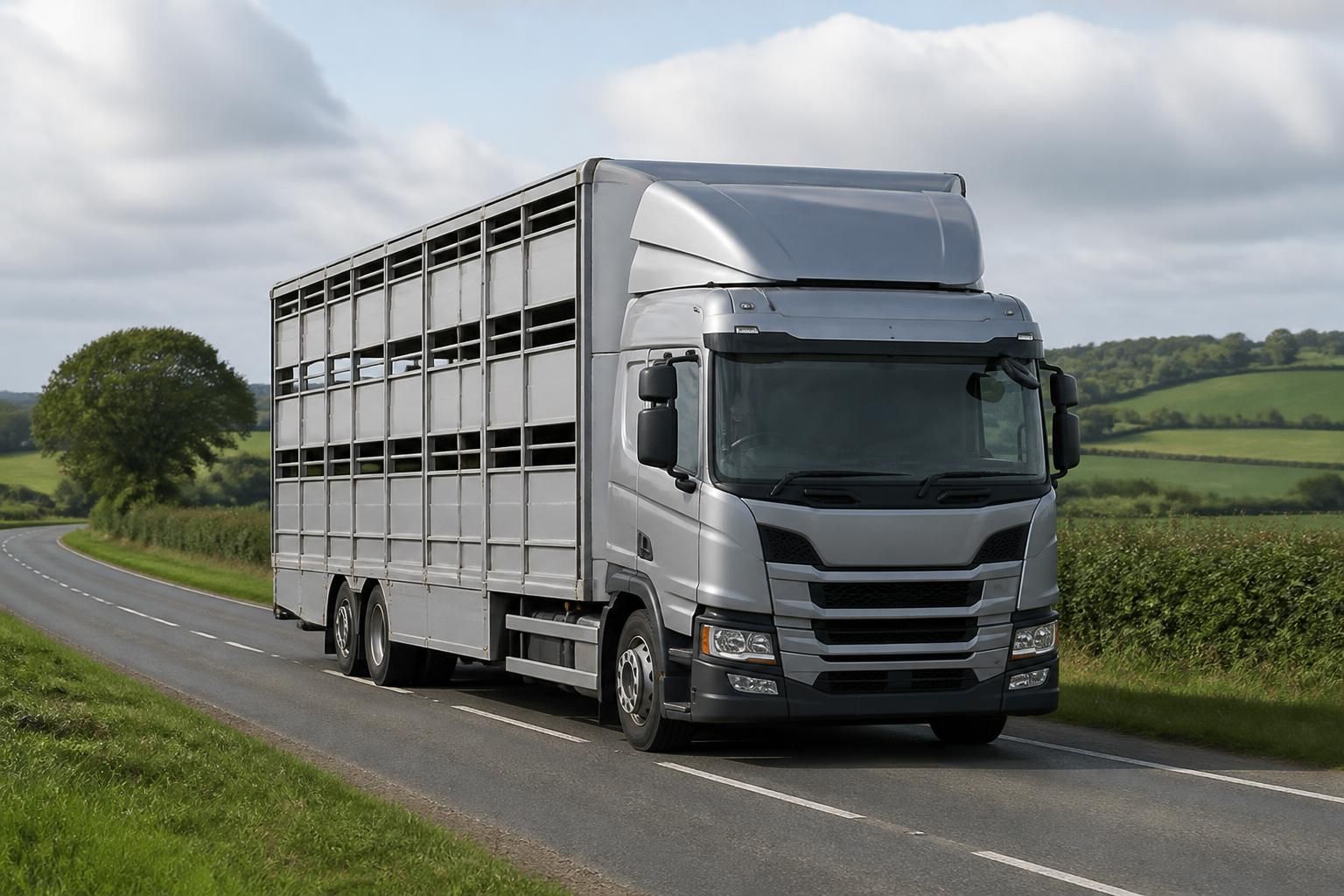
Livestock lorry cover
Livestock lorry insurance for cattle, sheep and pig carriers
For farmers moving their own stock and hauliers carrying animals for others. One short form reaches specialist livestock lorry brokers.
- Rigids and multi-deck artics
- Own stock or haulage
- Animals in transit
Quick answer
Livestock lorry insurance is motor cover for a goods vehicle or trailer built to carry live animals, such as a cattle lorry, a farm stock lorry or a multi-deck sheep and pig trailer. It protects the lorry on the road and the third parties around it. Cover for the animals themselves, known as animals in transit or livestock in transit, is usually a separate section or policy, and the class of use depends on whether the stock belongs to you or to a customer.
Livestock lorry cover at a glance
- The motor policy insures the lorry; death or injury to the animals on board is normally a separate cover.
- A farmer hauling its own cattle to market is rated differently from a firm carrying stock for paying customers.
- Moving animals as a business generally requires an authorisation, and drivers on longer trips need proof of competence.
- Insurers take an interest in decks, ramps, partitions and how the body is cleaned between loads.
- Farm tracks, field gateways and narrow lanes form part of the working day for many livestock vehicles.
What livestock lorry insurance covers
A policy for an animal carrier usually combines standard HGV motor cover with options built around a live load. Knowing which parts are included and which are extras makes quotes easier to compare.
Livestock lorry types and what insurers look at
The body, the number of decks and the size of the outfit all affect how an insurer prices the vehicle and the animals it carries.
| Livestock vehicle | Usual loads | What insurers look at |
|---|---|---|
| Rigid lorry with a single-deck livestock body | Cattle and calves between farms, markets and abattoirs | Ramp condition, partitions, farm access and local mileage |
| Rigid with a double-deck or removable deck | Sheep, lambs and pigs on shorter runs | Deck mechanism, ventilation, how heavy loads are spread |
| Drawbar outfit with a livestock trailer | Mixed loads of sheep and cattle from several farms | Coupling, trailer value and handling on rural roads, as covered on drawbar lorry insurance. |
| Artic with a multi-deck livestock trailer | Large consignments of sheep or pigs over longer distances | Hydraulic decks, journey length, water and ventilation systems, tractor unit cover on artic lorry insurance |
Horseboxes are rated as a separate class, with different users and values, and are covered on our horsebox lorry insurance page.
Moving your own stock or other people's animals
Who owns the animals on board is the starting point for any livestock lorry quote. It changes the class of use on the motor policy and the sort of animal cover that makes sense.
Farmers and dealers moving their own stock
A farm taking its own lambs to market or bringing store cattle home usually insures the lorry for carriage of own goods. Further detail is on our own goods HGV insurance page.
Livestock hauliers
Carrying animals that belong to farmers, dealers or processors for a fee needs haulage use, and customers often expect proof of animals in transit cover. Our haulier insurance page explains the wider picture.
Which class of use fits a farmer who also moves a neighbour's sheep for payment?
- NoSocial, domestic and pleasureNot designed for a commercial animal carrier of any size.
- NoCarriage of own goodsOnly your own animals, carried for your own farm or trading business.
- YesHaulage, or hire and rewardStock owned by someone else, moved in return for payment, even if only now and then.
Paperwork brokers often request
Moving animals for a business beyond a short local distance generally needs a transporter authorisation, and drivers or attendants on those journeys are expected to hold a certificate of competence. Vehicles used on long journeys, a higher threshold again, may also need to be inspected and approved. A broker may ask to see these alongside your operator licence when you begin a livestock lorry quote (opens in a new tab).
What affects the price of livestock lorry insurance
An animal carrier is priced on the vehicle, the driver and the value and type of stock it moves, with the journey itself adding further factors.
Out on the road
Narrow lanes, steep farm tracks and soft field gateways, plus a load that can sway on bends and under braking.
At the farm, market or abattoir
Reversing into pens and loading bays, ramps lowered onto uneven ground, and stock handled in busy yards.
- Type and value of animalsPedigree cattle or breeding stock carry far more value per head than store lambs, which affects animals in transit limits.
- Own stock or hire and rewardCarrying for paying customers usually costs more than moving animals your own business owns.
- Driver experience and competenceTime spent handling and driving livestock, along with any welfare training, is weighed by insurers.
- Body condition and maintenanceSound decks, non-slip floors, working ramps and secure gates point to a well-kept vehicle.
- Journey length and patternLocal farm-to-market work and long runs to distant abattoirs present different risks.
- Number of livestock vehiclesSeveral rigids and artics may be grouped on HGV fleet insurance.
Cover that often sits alongside livestock lorry insurance
The motor policy is one part of the picture for an animal carrier. These covers fill gaps that a lorry policy may leave open.
Before you buy
Questions worth asking about livestock lorry cover
Policies for animal carriers differ mainly on the animals themselves and the moments either side of the drive. Brokers can usually clarify these points before cover starts.
- Are the animals covered, or only the lorry?Animals in transit may be an optional section, a separate policy or not offered at all.
- What causes of death or injury are included?Accident, fire and overturn are commonly covered, while illness or stress-related losses are often excluded.
- Is there a limit per animal or per load?High-value pedigree stock may need a higher limit agreed before the journey.
- Does cover include loading and unloading?The time on the ramp and in the pens is where some policies stop and others continue.
- Is humane slaughter on a vet's advice covered?Some insurers pay when an injured animal is put down after an accident, others only for death at the scene.
- Are separate trailers included?Drawbar and artic livestock trailers may be listed on the policy or need cover of their own.
- Does the class of use match the work?Occasional paid moves for neighbours can turn own goods use into haulage.
- What happens to the animals after a breakdown?Recovery and transfer of a live load to another vehicle varies between policies.
How it works
How to get a livestock lorry insurance quote
HGV Insure is an information site, not an insurer or a broker. We link to MyMoneyComparison.com, a comparison service that can put farmers and livestock hauliers in touch with specialist brokers.
- 1
The quote form
Get my livestock lorry quote takes you to MyMoneyComparison.com, our comparison service.
- 2
Your livestock lorry and the work
The form asks about the lorry, its weight and body, your operator licence and who drives. The broker follows up on the animals carried and whether they are yours.
- 3
Options from a broker
A livestock specialist gets in touch with what insurers can offer, subject to their acceptance criteria. Nothing has to be bought.
FAQs
Livestock lorry insurance FAQs
What is livestock lorry insurance?
It is HGV insurance for a lorry or trailer fitted out to carry live animals. It covers the vehicle and third parties, and can be paired with animals in transit cover for the stock on board.
Does my lorry policy cover animals that die or are hurt in transit?
Usually not on its own. Death or injury to the animals is normally a separate section or policy, and it tends to cover specific events such as a crash, fire or overturn rather than every loss.
Will goods in transit insurance cover livestock?
Often not. Many goods in transit (opens in a new tab) policies exclude live animals, so livestock carriers usually rely on dedicated animals in transit cover instead.
Do I need an authorisation to transport animals?
Usually, for business journeys beyond a short local distance. Longer journeys bring extra requirements for drivers, attendants and vehicles, while short local moves, including many farmers moving their own stock, are treated differently. The relevant animal health authority sets out which requirements apply.
Do I need a certificate of competence to drive a livestock lorry?
For business journeys beyond a short local distance, drivers and attendants handling animals are generally expected to hold one, and insurers may ask for it. Short local moves are treated differently, and the requirement depends on the journey rather than the size of the lorry.
Does cleaning and disinfecting the lorry affect my insurance?
Livestock vehicles are expected to be cleansed and disinfected after each load, and markets and abattoirs often check. Good cleaning records point to a well-run operation, and some insurers may ask how it is done.
Is a farmer's cattle lorry insured differently from a livestock haulier's?
Yes. A farm moving only its own animals usually insures for carriage of own goods, while a firm moving stock for others needs haulage use. The own goods cover page has more on the distinction.
Are multi-deck livestock trailers covered with the tractor unit?
Not always. Some policies include trailers when coupled, while others list each trailer separately, particularly valuable hydraulic-deck units. Options are set out on our HGV trailer insurance page.
Is a horsebox treated as a livestock lorry?
Normally no. Horseboxes have their own market, with private, competition and commercial users. Our horsebox lorry insurance page covers them.
Does HGV Insure sell livestock lorry insurance?
No. HGV Insure is an information site and a trading style of Mymoneycomparison.com Ltd, the company behind MyMoneyComparison.com, which matches operators with specialist brokers. When you start a quote you continue to MyMoneyComparison.com, where quote requests are subject to insurers' acceptance criteria.
Ready to get your livestock lorry covered?
One form, specialist HGV brokers, no obligation.
Get my livestock lorry quote (opens in a new tab)